

I’ve mentioned before that I have ADHD. It comes with sensory issues. Sound is one of them. I cannot filter out background noise and hear everything in my surroundings. Another is how something feels on my skin. I have to choose the clothes I buy very carefully, otherwise, I will be distracted by how they feel on my skin. For the same reason, I never carry physical cash because it usually feels irksome to touch or feel through the fabric of what I’m wearing, crumpled up in a pocket. Instead, I use mobile money apps and occasionally credit cards. Funny story, a few times I have unknowingly thrown away a note from my pocket because I could feel it through my trousers or shirt, and my brain compelled me to do the natural thing to make me more comfortable.
The problem with dealing with digital money is that you lose perspective. Somehow, a 100-dollar bill seems more real and important than $100 on an app; which is better than a card because you have to look for a card’s balance, but on a money app, the balance is usually the focal point. I find that I spend less when I use physical cash than when I use digital money, which brings me to crypto.
If you took some crypto and a bunch of traditional assets, say currencies, indices, and commodities, and then calculated their annualized volatility on an arbitrary timeline, you find that cryptocurrencies are more volatile. Here is what that looks like from March 8th, 2020 to last Thursday.
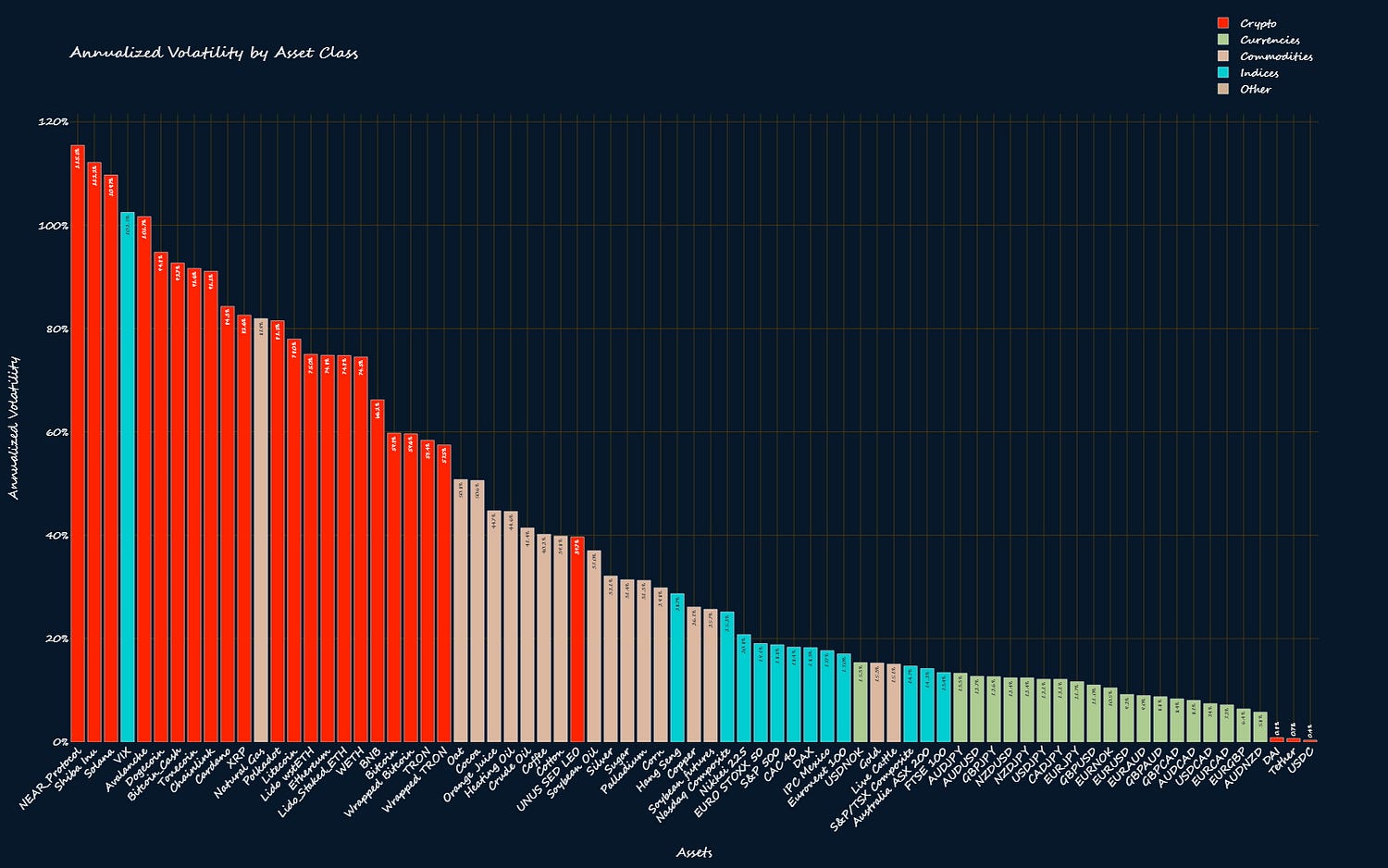
Three cryptocurrencies are more volatile than the volatility index (VIX), one of which is Solana, the new hype coin. Of the 22 volatile cryptocurrencies (ignoring the three dormant ones on the right), Bitcoin is the fifth least volatile and Ethereum is the ninth least volatile (I will refer to this observation later in the article).
Think about the nature of the assets we have here. Commodities are physical assets; indices are baskets of legal ownership to real-world companies in different countries; and currencies represent the differences in the value of real-world money in different sovereignties. All these assets so far have a place in the real world, and have physical representations of some kind. What’s left? VIX and cryptocurrencies, both of which rely on mathematics for their existence. In other words the purely digital or abstract ones.
The problem with purely digital assets is that it is hard for people to gauge the worth of their holdings. The frictionlessness of crypto, one of its main strengths, also means that when you spend it, you don’t see the bills leaving your hand, or your wallet emptying; you don’t wipe a card and get a corresponding notification on your phone. You don’t recognize that you are indeed spending something that took effort to earn. You forget that each transaction represents hard-earned capital, so you let your guard down even more than you would with a credit card or mobile app. To make matters worse, crypto’s worth is based on sentiment and momentum precisely because it doesn’t represent anything tangible in the real world. Yes Bitcoin has scarcity, and Ethereum has utility, but to most investors, these details are secondary to the moonshot they foresee.
Notice that in the chart above, the less established a coin is, the more volatile it is. Interestingly, Bitcoin, the poster child for crypto, is one of the least volatile cryptocurrencies, and Ethereum is not far off either. But they are both more volatile than traditional assets, which hammers home the point that crypto is generally more volatile. When it comes to crypto, everyone is a cartoon with dollar signs for eyes making them perfect for gambling.
I once read somewhere that unearned money is the sweetest thing in the world — sweeter than even sex. You can make a lot of money in any of the traditional assets, but there is no sweeter money than buying a dumb meme coin and watching it go to the moon. It’s a better high. Even if the actual money you make is not that much, it feels better than making money in traditional assets. This is why people are so irrational about crypto, it’s also why momentum trading strategies work so well in crypto, and why crypto has been called a pyramid scheme.
Irrationality is accepted as a feature of the crypto world. Like religion, you are supposed to believe in the new hype coin wholeheartedly and unquestioningly to make money from it. When a coin starts to go up, it continues going up based on hype and FOMO; when it goes down, it continues going down because everyone is rushing to preserve their gains. Other assets do the same, but at some point, they move towards some value that is ‘fair’ given their circumstances.
The house money effect is a theory used to explain the tendency of investors to take on greater risk when reinvesting profit earned through investing than they would when investing their savings or wages. — Investopedia
In trading and gambling, there is a phenomenon known as the ‘house money’ effect whereby once you make some money, you start taking stupid risks that you wouldn’t normally take — or you withdraw it and spend it frivolously. The house money effect happens for two reasons. One is that you have just made what feels like free money — all you did was press a few buttons more or less. The other is that the money is digital — just a better number on your screen. This phenomenon is more pronounced in the crypto world because crypto doesn’t represent anything tangible. I’m not making a moral judgment here; most money is just numbers in a database — at least crypto has blockchains. But if you want your non-crypto money in cash, so you can put it in your pocket and be uncomfortable all day, you can go to an atm and withdraw some. If you want your Bitcoin instead, there’s nothing you can do. This absence creates a vacuum that needs to be filled, quickly. When money is not nailed down to the floor like fiat is, it becomes something to play with.
The house money effect is also why there are so many meme coins. If crypto is a serious asset class that stands for its initial values, most coins should have taken a dirt nap by now. Some indeed address the shortcomings of Bitcoin, like Ethereum for example, but most exist for no real reason. While there are true believers in crypto’s tenet, most people buy them to feel what it’s like to get free money — they essentially buy lottery tickets. Consequently, crypto profits neither feel real nor earned like profits from traditional assets. People make money on Bitcoin, cash out, and then buy some other meme coin; partly to chase that feeling of free money, and partly due to the house money effect. When buying Bitcoin, they ask themselves “Why not?”. After making some gains, they then ask themselves “What’s a little more risk to me?” This is the house money phenomenon in effect. It leads to a self-perpetuating cycle of risk-taking where early profits lead to investments in riskier coins, which is why the less established a coin is, the more volatile it generally is on our chart.
So, those who make money in crypto end up spending it on riskier altcoins or flashy and lavish things. I don’t mean to generalize, of course; they are not all like that. But this is how the media and social media portray the stereotypical ‘crypto bro’: somewhat flashy, eccentric, and perhaps even wasteful. Most investors look for financial freedom, but crypto bros chase after a feeling — a high that only comes from free money. When it wears off, they continue chasing it in even riskier altcoins aka shitcoins.
That crypto became part of our culture signifies our shifting mentality on money. Some statistics show Americans are generally gambling more and more, especially in sports and in the markets with things like 0DTE options. Part of this increase in risk-taking is due to the psychological effects of using digital money, notably the house money effect.
I don’t have any moral qualms about gambling, but I know that in both gambling and trading, to develop an actual edge and make money consistently, one of the things you should do is create friction between your risk capital and the markets. For instance, you can use an expensive broker, or you can deposit money every time you make a trade, and withdraw it after you close it. Both options force you to incur transaction costs and make you think harder about placing a trade. Consequently, you will take more of the trades you believe in and fall less victim to the house-money effect and gambling in general.
This song is stuck in my head :/